
Mali attacks spotlight the growing reach of militants across West Africa
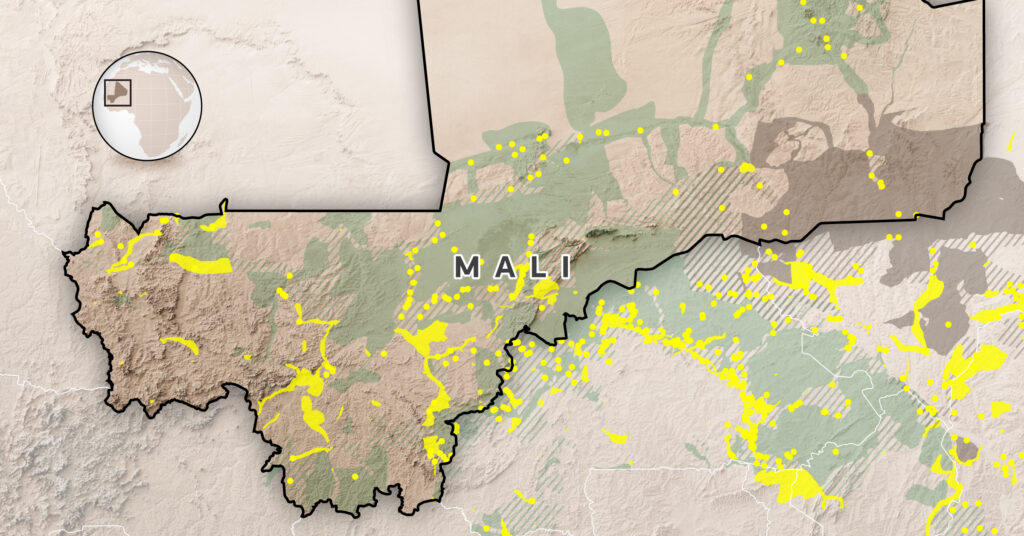
A map of Mali showing incidents of violence involving militant groups and JNIM – Al Qaeda and ISSP support zones.
Simultaneous attacks in Mali by militants linked to al Qaeda and separatist Tuareg rebels launched on April 25 showed how fighters from different groups with different goals were able to strike at the heart of the West African country’s military government.
The insurgents killed Mali’s defence minister, seized military bases and towns in Mali’s north on the fringes of the Sahara Desert and said they were imposing a total blockade of the capital Bamako in the south of the vast landlocked country.
Despite a series of interventions since 2013 by French, U.S., UN and Russian troops, these militant groups, alongside other factions aligned with Islamic State, have also made significant gains elsewhere in the region.
The groups have expanded their presence in Mali’s neighbours Niger and Burkina Faso and have also linked up with Islamist militants in northern Nigeria. Their reach now stretches over 3,000 km (1,900 miles) from western Mali near Senegal, through Nigeria and into Chad – roughly equivalent to the distance from Brussels to Beirut.
Major gold, lithium and uranium mining operations are increasingly at risk, as are a string of other countries along West Africa’s coast.
“Terrorism in the Sahel is not only a regional dramatic reality. Progressive links of its groups in Africa and beyond make it a growing global threat,” UN Secretary-General Antonio Guterres said in November.
Key groups in the conflict
Goita, a special forces officer who has taken part in two successful coups in Mali, has led the country since 2021. He promised to restore democracy, but elections have been pushed back, with Goita saying security needs to be fully secured first.
In his first public appearance three days after the April 25 attacks, Goita said the situation was under control and vowed to “neutralise” those responsible
A veteran of the decades-long Tuareg separatist movement, Ag Cherif led an uprising in 2012 to carve out a desert state called Azawad in northern Mali. The separatists, known then as the MNLA, also fought alongside al Qaeda-aligned factions but were soon sidelined by the more powerful Islamists.
Ag Cherif signed a peace deal with the government in 2015 but it collapsed soon after Mali’s new military government seized power. The Tuareg-led separatists, now known as the FLA, have once again joined forces with the Islamist militants.
Ag Ghaly cut his teeth in Tuareg rebellions in the 1980s and 1990s and emerged as a key power broker between Bamako and an array of players in Mali’s desert north.
By 2012, Ag Ghaly was leader of the Ansar Dine Islamist group that broke away from the separatist rebels and pushed for the establishment of Islamic law in northern Mali. In 2017, he oversaw the merger of a collection of Islamist groups that became JNIM. He is wanted by the International Criminal Court (ICC) for war crimes.
ISSP was born out of the array of Islamist factions that seized northern Mali in 2012. It has established itself in a zone along the borders of Mali, Burkina Faso and Niger. ISSP now governs some of these areas but faces competition from JNIM, as well as the three countries’ armies.
The rival Islamist factions have clashed hundreds of times since 2019, resulting in more than 2,100 deaths, according to Armed Conflict Location & Event Data (ACLED), a conflict monitoring group.
Russia’s military support to Mali was initially provided by the Wagner mercenary group. Last year, operations were taken over by Africa Corps, a force controlled by the Kremlin. Most Africa Corps members were previous Wagner fighters and both groups have been accused of human rights abuses in Mali, allegations rejected by Russia.
Russia has become Mali’s main military backer since the soldiers who seized power in 2020 kicked out UN and Western forces. Burkina Faso and Niger, also run by soldiers who ousted civilian administrations and promised to defeat the various insurgencies, have similarly turned to Moscow for military support.
There are currently about 2,500 Russians deployed across 20 bases in Mali, according to Investigations with Impact (INPACT), a group that examines Russian operations.
Hundreds of Russians have withdrawn from bases in the north since Saturday’s attacks, raising questions about the future of Russian support to Mali and denting Russia’s image as a guarantor of security in Africa. Russian state media said Africa Corps soldiers prevented a coup on April 25 and protected strategic sites. The Kremlin said on April 30 that Russian forces would stay in Mali to help the government.
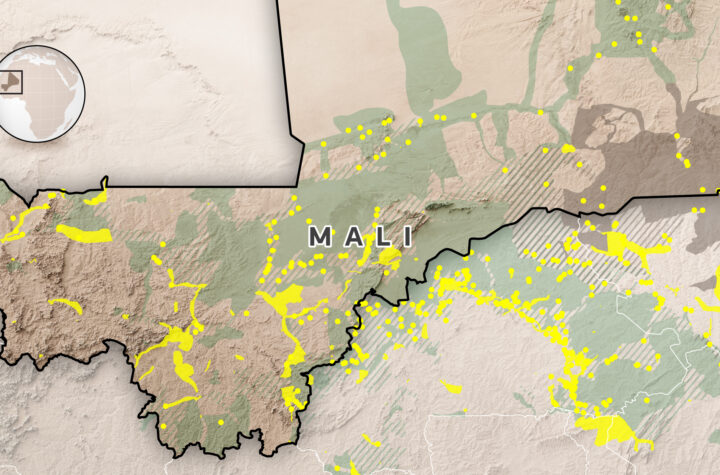
A map of Mali showing locations of confirmed Russian withdrawals after the JNIM‑FLA offensive.
In recent years, the Islamists have consolidated their gains in largely rural areas, recruiting fighters and gaining political traction – just as Islamist rebels did in Syria – rather than carrying out spectacular attacks that draw international attention.
Once only a few hundred gunmen confined to a small pocket of the Sahara, Islamists allied to either al Qaeda or Islamic State now strike freely across Mali, operate across about 60% of Burkina Faso and through much of southern and western Niger. Four million people have been displaced by the violence, according to the UN.
Together, the Islamic State and al Qaeda factions in West Africa have between 15,000 and 22,000 fighters, according to UN estimates, while Mali’s Tuareg separatists can also muster thousands of men.
As their influence has spread, Islamists have threatened the northern areas of Benin, Togo, Ghana and Ivory Coast. A long-running insurgency in northeastern Nigeria has morphed into Islamic State’s most dangerous affiliate, moving west and linking up with other jihadis across the Sahel.
A map showing incidents of political violence and major mines in the Sahel region of western Africa
West Africa produces about 11 to 12 million ounces of gold a year, according to consultancy GlobalData, or 10% of global output. Ghana, Mali, Burkina Faso and Guinea host dozens of industrial mines which operate alongside small-scale artisanal mines that churned out an additional 4.8 to 6.4 million ounces in 2024, according to nonprofit organisation Swissaid.
West Africa holds significant reserves of bauxite and iron ore, as well as critical minerals including lithium, copper and cobalt. Niger is a major uranium producer which supplied about 25% of Europe’s needs in 2022, according to the EU. Niger’s military government seized the main French-owned uranium mine last year, cutting off exports to Europe.
Mining companies have ramped up security spending in recent years as the Islamists expand their reach. Some mines have been targeted and there is increased concern over the viability of supply routes.
Years of violence coupled with economic deprivation have increased the number of West Africans trying to make it to Europe. Journeys are expensive and dangerous, however, as migrants must first cross the Sahara to reach countries along the Mediterranean coast, or make the long trek to Senegal and Mauritania to board small boats for the perilous voyage to Spain’s Canary Islands.
The number of West Africans making it to Europe has not come anywhere close to the levels of migration from Syria at the peak of its civil war.
Sahel experts also warn that if the jihadist groups veer from their current drive to consolidate their regional power bases, they could eventually threaten Europe and the United States.
Edited by
David Clarke and Jon McClure
Plus d'histoires
Soutien agricole russe au Niger : un levier stratégique pour l’autonomie alimentaire
Maintien en détention de Kemi Seba en Afrique du Sud et perspective d’extradition vers le Bénin
Tanzanie : le gouvernement publie un bilan controversé des violences post-électorales